
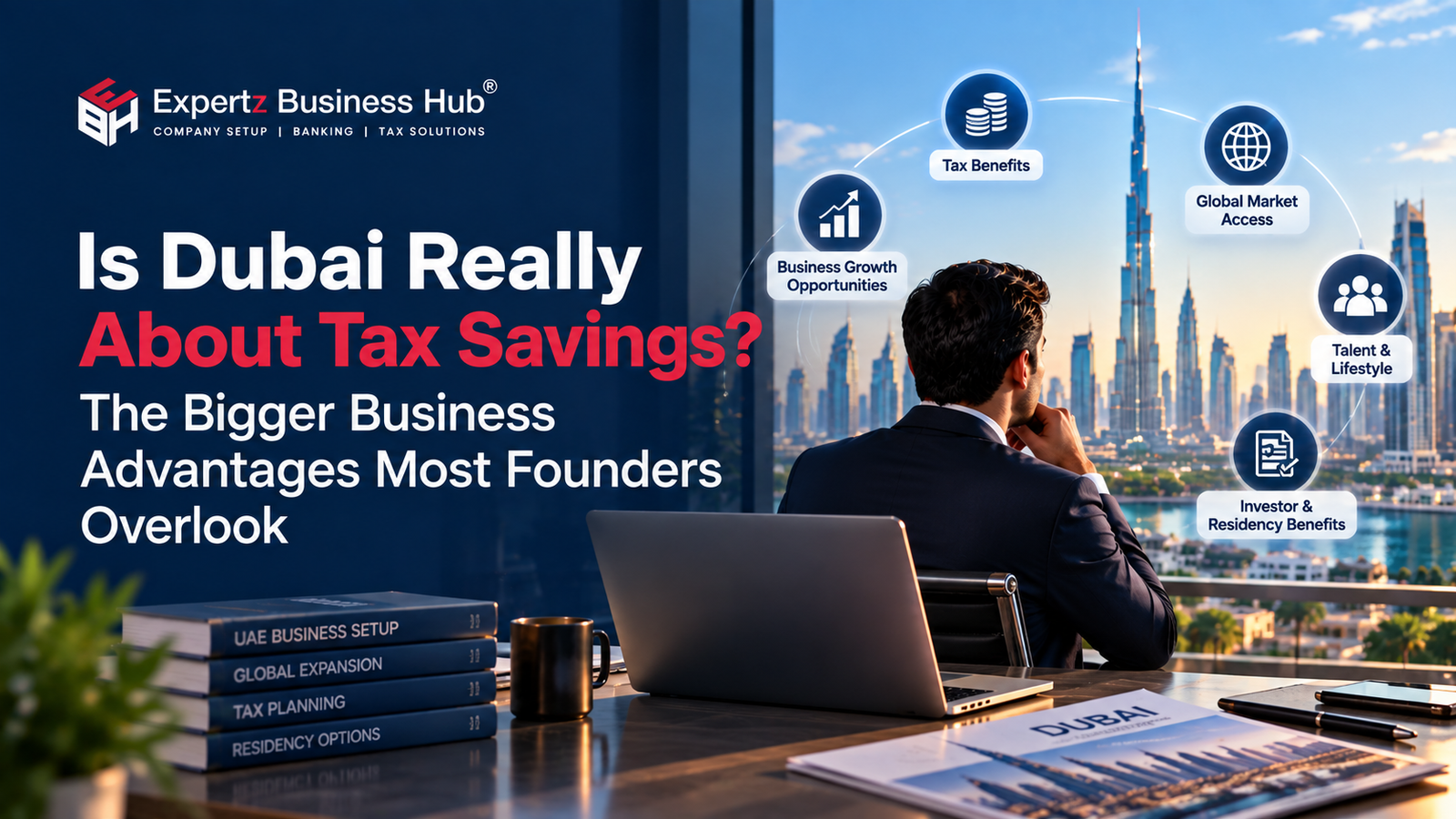
Ask ten founders why they want a Dubai company and at least seven will say the same thing: tax.
It's an understandable answer. For decades, the UAE was known as a jurisdiction with no federal corporate income tax for most businesses. But that picture changed in June 2023, when the UAE Corporate Tax regime came into effect. Today, entrepreneurs who still treat Dubai as a "zero-tax" shortcut can end up choosing the wrong structure, overlooking compliance requirements, or making assumptions about tax treatment that don't apply to their business.
The better question isn't "how much tax will I save?" It's "what can this jurisdiction do for my business that my home market can't?"
The answer to that is where Dubai's real value sits.
The Tax Picture in 2026: Still Competitive, No Longer "Zero"
Let's deal with tax first, because it still matters.
How UAE Corporate Tax Works Today
0% on taxable income up to AED 375,000, and 9% on taxable income exceeding AED 375,000 for taxpayers subject to the standard Corporate Tax regime. A company with AED 1 million of taxable income, for example, would have a Corporate Tax liability of AED 56,250 before considering any applicable reliefs, exemptions or tax credits.
Small Business Relief (SBR) allows eligible UAE resident persons to elect to be treated as having no taxable income for a tax period, provided the applicable conditions are satisfied. One important condition is that revenue must not exceed AED 3 million in the relevant tax period and all previous tax periods. Qualifying Free Zone Persons and certain members of large multinational groups are not eligible to elect for the relief.
In 2026, Ministerial Decision No. 131 of 2026 extended the period during which the AED 3 million revenue threshold applies to tax periods ending on or before 31 December 2029. The AED 3 million threshold itself was not increased.
Qualifying Free Zone Persons (QFZPs) can benefit from a 0% Corporate Tax rate on Qualifying Income, while taxable income that does not meet the qualifying-income requirements is generally subject to the standard 9% rate. The 0% treatment is conditional and depends on meeting the relevant requirements under the Corporate Tax regime.
Large multinational enterprises within the scope of the UAE Domestic Minimum Top-up Tax may be subject to the 15% global minimum tax framework. The UAE DMTT applies to relevant MNE groups with consolidated global revenue of €750 million or more in at least two of the four financial years preceding the relevant year. The UAE DMTT applies for financial years beginning on or after 1 January 2025.
VAT remains 5%, subject to the applicable zero-rated and exempt categories under UAE VAT legislation.
The UAE does not levy personal income tax on individuals.
By global standards, that's still a competitive tax environment. But notice the pattern: the benefits come with conditions, eligibility requirements, elections and compliance obligations.
Why "Tax-Free" Thinking Causes Problems
The UAE's Corporate Tax regime is not simply about whether a company is located in Dubai or a Free Zone.
Taxable persons subject to Corporate Tax must register with the Federal Tax Authority and comply with the applicable filing and payment requirements. The FTA has also confirmed that businesses eligible for Small Business Relief still have filing obligations, including the submission of simplified Corporate Tax returns within the prescribed timeframe.
Similarly, a Free Zone company does not automatically receive 0% Corporate Tax simply because it has a Free Zone licence or address. The 0% rate applies to Qualifying Income of a Qualifying Free Zone Person, subject to the relevant conditions.
Compliance is also becoming increasingly digital. UAE e-invoicing is being introduced in phases. Businesses with annual revenue of AED 50 million or more that fall within the system must appoint an Accredited Service Provider by 30 October 2026 and implement e-invoicing by 1 January 2027. Other in-scope businesses have later deadlines, including implementation by 1 July 2027.
None of this is a reason to avoid Dubai.
It's a reason to stop choosing Dubai only for tax.
The Advantages That Outlast Any Tax Rate
Tax rates can change. The following advantages are structural, and they're part of the reason Dubai continues to attract entrepreneurs and international businesses.
1. A Genuine Gateway to Several Markets at Once
Dubai sits within a few hours' flight of the GCC, South Asia, East Africa and much of Europe. For trading, logistics and service businesses, that geographic position can support regional expansion, international client servicing and access to multiple markets.
The UAE's treaty network adds another layer for businesses operating internationally. According to the UAE Ministry of Finance, the UAE has concluded 137 Double Taxation Agreements (DTAs) with trading partners. These agreements can help address double taxation and may provide reduced withholding rates or other treaty benefits, depending on the relevant treaty and the taxpayer's circumstances.
However, treaty availability should always be checked country by country. For example, the UAE does not currently have a comprehensive income-tax treaty with the United States, while the UAE-Germany income tax treaty ceased to apply on 31 December 2021. Other tax-information exchange and international cooperation arrangements may nevertheless apply.
2. An Economy That Is Still Growing Fast
Opportunity follows growth.
Dubai's GDP reached AED 937 billion in 2025, representing growth of 5.4% for the year.
Dubai also ranked first globally for greenfield foreign direct investment projects for the fifth consecutive year in 2025, according to data from the Financial Times' fDi Markets database. The emirate recorded 1,253 announced greenfield FDI projects in 2025, up 10.5% from 2024.
Those numbers matter to smaller businesses too. More regional headquarters and international investment can translate into more potential corporate clients, supplier opportunities and partnerships.
The Dubai Economic Agenda (D33), which targets doubling the size of Dubai's economy by 2033, also provides a clear indication of the emirate's long-term economic direction.
3. Flexible Ownership and Structuring
Foreign investors can own 100% of most mainland companies, although certain strategic activities remain subject to specific restrictions or approvals.
Alongside the mainland, the UAE's Free Zones provide different structures and ecosystems suited to activities such as trading, consulting, technology, media, commodities and holding structures.
This flexibility is an advantage in itself.
A founder may choose a mainland structure where direct access to the UAE market is important, a Free Zone structure where the business model and qualifying activities fit that framework, or potentially use more than one entity as the business expands.
The right choice depends on the company's activities, customers, ownership, operational requirements and growth plans.
4. Access to Talent, and a Place People Want to Live
The UAE's international workforce is one of its major business advantages. Dubai attracts professionals and entrepreneurs from a wide range of countries and industries.
The UAE also offers long-term residence options for eligible investors, entrepreneurs, specialised professionals and other qualifying categories. The Golden Visa, for example, can provide renewable residence for five or ten years depending on the category and eligibility requirements.
For many business owners, this is an important consideration.
They aren't just moving a company; they may be building a long-term base for themselves and their families.
5. Credibility with Banks, Partners and Investors
A properly structured UAE company, supported by genuine business activity, appropriate substance, accurate accounting and a clean compliance record, can provide a credible platform for working with banks, investors, suppliers and international clients.
The introduction of Corporate Tax and stronger tax-compliance frameworks has also made accurate financial reporting and tax governance increasingly important for businesses operating in the UAE.
The key point is simple: a UAE company should be built as a real business structure, not merely as a licence or tax vehicle.
A Practical Example
Consider a hypothetical consultant relocating from India who establishes a Dubai company with AED 2.4 million in revenue and AED 900,000 in taxable profit.
Under the standard Corporate Tax calculation, the liability before considering any applicable reliefs would be AED 47,250: 0% on the first AED 375,000 and 9% on the remaining AED 525,000.
If the consultant satisfies all applicable Small Business Relief conditions, including the AED 3 million revenue threshold for the relevant and previous tax periods, and makes the required election, the business may be treated as having no taxable income for that tax period.
But that saving is not what makes the move work.
What makes the move potentially valuable is the ability to serve clients across regional and international markets from one base, access an international talent pool, establish a long-term presence in the UAE where eligible, and build a properly structured business with appropriate compliance.
The tax treatment can help.
The business model is what lasts.
Key Takeaways
- Dubai and the UAE remain highly competitive from a tax perspective in 2026, but the system is not simply "tax-free" and benefits are subject to specific rules and eligibility requirements.
- Small Business Relief remains available to eligible businesses meeting the relevant conditions, including the AED 3 million revenue threshold, which has now been extended to tax periods ending on or before 31 December 2029.
- Free Zone 0% Corporate Tax applies to Qualifying Free Zone Persons on Qualifying Income, subject to the applicable conditions.
- UAE e-invoicing is being introduced in phases from 2027, with preparation and Accredited Service Provider deadlines beginning in 2026 for larger businesses.
- The UAE's broader business advantages include market access, economic growth, foreign ownership flexibility, international talent, residency options and an established business ecosystem.
Conclusion
Dubai is not simply a tax strategy.
It is a well-established international business hub that combines a competitive tax environment with access to markets, infrastructure, talent and investment opportunities.
Founders who build their plans around the broader business advantages—and treat tax efficiency as one component of the overall strategy—are better positioned to choose a structure that fits their actual business needs and compliance obligations.
The key is not simply to ask, "How much tax will I save?"
It's to ask: "What structure will allow my business to operate, grow and remain compliant in the UAE?"
Planning Your Move to Dubai?
The right licence, jurisdiction and tax position depend on your activities, your clients, your ownership structure and where you plan to grow.
Expertz Business Hub helps entrepreneurs and companies explore business setup options across Dubai's Free Zones and mainland, along with related corporate services and compliance support.
Speak with an advisor to understand which structure may fit your business and what Dubai can offer you beyond tax.
What drew you to Dubai: the tax, or something bigger? Share your view in the comments.
Looking beyond the tax rate? Speak with our consultants to find the structure that actually fits your business, your clients and your growth plans.
Contact Us TodayThis article is for general informational purposes only and does not constitute tax, legal or financial advice. UAE tax treatment depends on the specific facts and circumstances of each business. Regulations and administrative requirements may change; businesses should confirm their position with the Federal Tax Authority, Ministry of Finance, relevant licensing authority or a qualified professional adviser.