
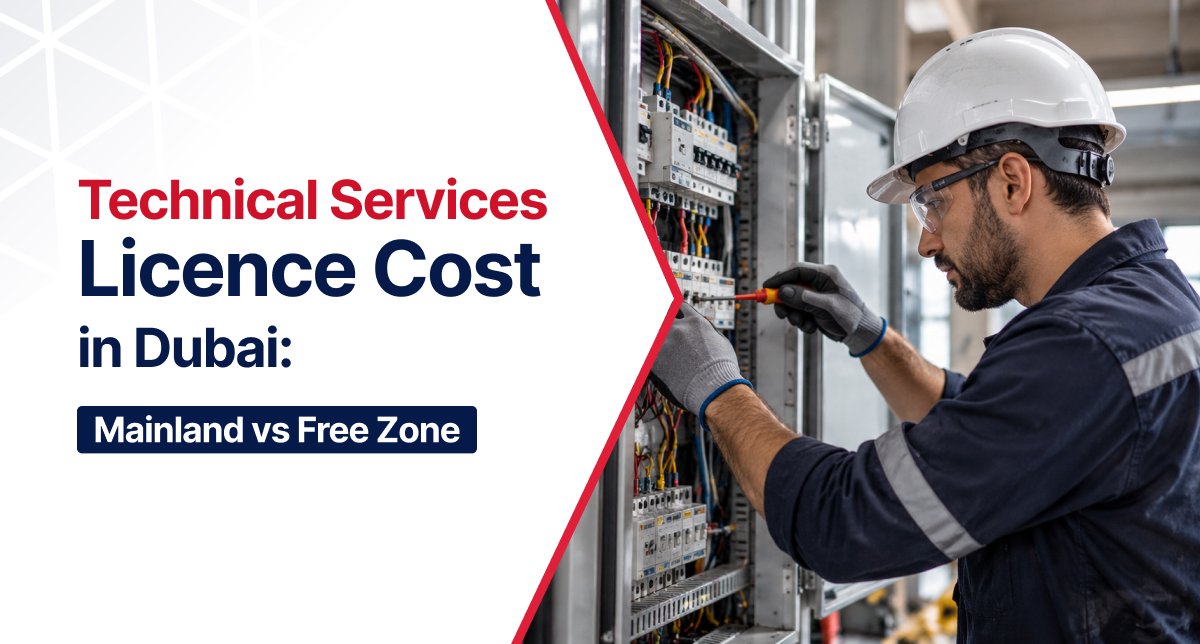
Ask five setup consultants what a technical services licence costs in Dubai and you'll likely get five different numbers. That isn't because anyone is guessing. It's because the licence fee is only one line in a much longer bill, and the bigger decision — mainland or free zone — changes almost every line after it.
This guide breaks down where the money actually goes, why the cheaper option on paper can become the expensive one in practice, and how to pick the right jurisdiction for the work you plan to do.
What a Technical Services Licence Covers
A technical services licence lets a company carry out hands-on installation, repair and maintenance work, subject to the specific activities included on the licence and any additional approvals required.
Typical activities can include:
- Air-conditioning, ventilation and refrigeration installation and maintenance
- Electrical fitting and electromechanical works
- Plumbing and sanitary installation
- Carpentry, tiling, painting and general building maintenance
- Solar panel and other equipment installation, where the relevant activity is permitted
Dubai Municipality's published contracting/activity classifications include technical building-services activities such as air-conditioning and ventilation installation and maintenance, electromechanical equipment installation and maintenance, plumbing and sanitary contracting, tiling, painting and carpentry. The exact activity classification matters because additional technical or regulatory requirements can apply to particular activities.
One licence can usually hold several related activities, depending on the licensing authority and the activities selected. This is why many founders start with a broader maintenance mix rather than a single trade.
The key word is hands-on. Most technical work happens at a client's villa, apartment, office or site. Where those clients are located should drive your jurisdiction choice more than the headline price.
Mainland Technical Services Licence Cost (DET)
On the Dubai mainland, the licence is issued by the Department of Economy and Tourism (DET). Setup advisers commonly quote a first-year range of roughly AED 15,000 to AED 30,000 for the licence and associated government/setup charges, although the actual amount can vary substantially depending on the legal form, activities, approvals and other requirements.
This figure should be treated as an indicative market estimate, not a fixed DET government tariff, and it generally excludes office rent and visas.
What Drives the Mainland Cost
- Trade name and initial approval — these are among the initial steps before the licence is issued. The exact trade-name fee depends on the name selected and applicable DET charges.
- Licence fee — varies according to the activities, legal form and licensing requirements.
- Physical office and Ejari — a mainland business generally needs a compliant business premises and tenancy documentation for licensing. The cost depends heavily on location, office size and lease terms. The UAE Government's mainland setup guidance lists selecting a location and submitting the lease contract as part of the licensing process.
- External approvals — certain activities can require approvals, registrations, inspections or technical compliance from relevant government bodies. This is particularly important for contracting and building-related activities. Dubai Municipality maintains specific standards for consultants and contractors, including activity classification and technical-staff requirements.
- Visas — each employee visa can add establishment/immigration charges, entry permit or status-change costs, medical testing, Emirates ID and health-insurance costs, depending on the employee and package.
Why Mainland Is Often the Right Call
A mainland licence is generally the straightforward route for a technical services company whose technicians need to work directly at client properties throughout Dubai.
That includes work for homeowners, building management companies, retailers, property operators and other businesses, subject to the exact licensed activities and any required approvals.
For businesses whose technicians are on client sites every day, that market access can be more important than saving several thousand dirhams on the initial licence package.
For certain contracting and engineering activities, Dubai Municipality registration, classification, professional requirements or other approvals may also apply. Dubai Municipality states that contracting companies in Dubai must meet its applicable conditions and registration requirements where those activities fall within its regulatory framework.
Free Zone Technical Services Licence Cost
Free zones such as Meydan Free Zone and IFZA advertise entry-level business licence packages from around AED 12,500, depending on the activity and package selected. For example, Meydan Free Zone currently advertises service and professional licence packages starting at AED 12,500, with its starting package including a flexi-desk/lease arrangement and zero visa allocation.
IFZA also allows multiple business activities on a single licence, subject to its activity rules and applicable charges.
The important point is that AED 12,500 is a starting package price, not a universal "technical services licence fee" across all free zones. Activities, visa allocations, establishment/immigration cards, office requirements and other services can change the final cost.
Visas push the number up quickly. Each one can add immigration, medical, Emirates ID and insurance costs, and the free zone may also charge for establishment or immigration-related services. A one-visa setup can therefore cost substantially more than the bare licence package in year one.
The Catch Most Quotes Don't Mention
A free-zone company does not automatically have unrestricted permission to conduct its licensed activities throughout Dubai's mainland.
This point has become more nuanced following Executive Council Resolution No. (11) of 2025, which regulates free-zone establishments conducting activities outside their free zone in Dubai.
Under the resolution, a free-zone establishment may conduct activities outside its free zone and within Dubai subject to obtaining the applicable licence or permit from DET, together with any approvals required by the government entity responsible for regulating that activity. The framework includes options such as a branch licence or a permit for specific activities.
The UAE Government also states that mainland market access for free-zone companies remains regulated and that direct mainland sales/services may require the appropriate mainland licence, additional approvals or other permitted arrangements.
So the earlier, simple statement that a free-zone company "cannot simply send technicians" is too absolute. It may be possible, but the free-zone licence by itself does not automatically authorise mainland technical work.
That makes the practical choice:
Good fit: engineering design and consultancy, remote technical support, project management for overseas clients, equipment trading and supply, and other activities that do not require unrestricted on-site mainland operations.
Potentially poor fit: on-site maintenance, repairs and installation for Dubai homes and buildings unless the required mainland permit/licence, branch or other approved arrangement is obtained.
For a business whose entire model depends on sending technicians to villas and buildings across Dubai, mainland licensing is often the simpler and more predictable structure.
There's Also a Tax Angle
There is an important distinction between where a company is incorporated and whether its income qualifies for the UAE's Free Zone Corporate Tax regime.
A Qualifying Free Zone Person (QFZP) can benefit from 0% Corporate Tax on Qualifying Income, while taxable income that does not qualify is generally subject to 9% Corporate Tax.
A QFZP must meet the applicable conditions, including maintaining adequate substance, deriving Qualifying Income, and complying with transfer-pricing requirements.
It is therefore too broad to say that all revenue from mainland customers is automatically non-qualifying. The treatment depends on the nature of the income and the applicable Qualifying Income rules.
The de minimis rules also allow certain non-qualifying revenue, provided the relevant threshold is not exceeded. The FTA states that the non-qualifying revenue must not exceed the lower of 5% of total revenue or AED 5 million for the relevant tax period.
So don't choose a free zone purely because someone promises "0% tax." The activity, income stream, substance and QFZP conditions should be reviewed before relying on the 0% rate.
Mainland vs Free Zone: Side-by-Side
| Factor | Mainland (DET) | Free Zone |
|---|---|---|
| Indicative licence cost, year one | AED 15,000–30,000* excluding office and visas | From about AED 12,500* depending on free zone/package |
| Office | Compliant premises generally required for mainland licensing | Flexi-desk may be included in entry packages |
| External approvals | May be required depending on activity | Depends on the free zone and activity; mainland work can require additional DET/other approvals |
| Serve Dubai homes and buildings directly | Generally the straightforward route, subject to activity approvals | Not automatically authorised by the free-zone licence; additional mainland licence/permit/branch or other approved arrangement may be required |
| Government and semi-government contracts | Can be eligible, subject to tender and contracting requirements | May require additional licensing/registration or an approved mainland arrangement |
| Best suited to | On-site maintenance, repair and installation | Consultancy, design, remote support, overseas-facing work and activities permitted by the chosen free zone |
| Mainland operating flexibility | High, subject to the licence/activity | Regulated; additional permissions may be required for mainland activities |
* Figures are indicative setup/package ranges, not fixed government tariffs. Final costs depend on activities, legal form, free-zone authority, visas, premises, approvals and other services. Always request an itemised quotation.
Two Practical Examples
An AC maintenance company serving villas in Arabian Ranches. The founder needs three technicians on visas, a van and contracts with homeowners and community managers. A free-zone licence may look cheaper initially, but the licence alone does not automatically authorise unrestricted mainland technical work. The founder should compare the cost and practicality of a mainland licence against the free-zone option plus the required DET/mainland permissions and activity approvals. For a business built around daily on-site Dubai maintenance, mainland will often be the more straightforward route.
An MEP engineering consultant designing systems for projects in Saudi Arabia and Oman. If the business is genuinely providing permitted consultancy/design services remotely and its chosen free zone accepts the relevant activities, a free-zone structure may be attractive. The founder should still check whether the work falls under Dubai Municipality's engineering consultancy/contracting regulatory framework and whether professional registration or technical-staff requirements apply.
Costs That Rarely Appear in the Headline Price
- Office rent and Ejari registration on the mainland
- Visa costs per employee, including medical, Emirates ID and health insurance
- Activity-specific approvals, registrations and inspections
- Technical staff or professional registration requirements where applicable
- Third-party liability insurance, which may be expected by clients for on-site work
- Bookkeeping and annual Corporate Tax compliance
- Licence renewal every year, which repeats applicable government/licensing fees
- Vehicle, equipment, tools and other operational costs for businesses sending technicians to customer sites
For contracting and engineering-related activities, Dubai Municipality's current regulatory framework should be checked before assuming that a basic trade licence alone is sufficient. Dubai Municipality publishes specific standards, classifications and technical-staff requirements for regulated contracting and engineering activities.
Don't Forget Corporate Tax
Every UAE business should assess its Corporate Tax registration and filing obligations. A resident juridical person established in the UAE, including a free-zone company, is generally required to register for Corporate Tax within the applicable FTA deadline. For entities established on or after 1 March 2024, the FTA's specified timeline generally requires registration within three months from incorporation, establishment or recognition.
The AED 10,000 late-registration penalty remains part of the rules, but there is an important current qualification: the FTA has an initiative to waive the penalty where the conditions are met, including submitting the first Corporate Tax return within seven months from the end of the first Tax Period. This should not be treated as a reason to delay registration.
Mainland businesses with revenue of AED 3 million or less may be able to elect for Small Business Relief, subject to the conditions and the requirement that the threshold is met in the relevant and previous tax periods. The Ministry of Finance has confirmed that the relief has been extended to tax periods ending on or before 31 December 2029.
A Qualifying Free Zone Person cannot claim Small Business Relief for the same tax period.
Key Takeaways
- Mainland technical-services setup costs are often quoted around AED 15,000–30,000 for initial licence/government-related setup, before office rent and visas, but this is an indicative market range rather than a fixed DET fee.
- Free-zone packages can start around AED 12,500, depending on the authority and activities, but visas and other requirements increase the total.
- A free-zone licence does not by itself give unrestricted permission to perform technical services in Dubai's mainland.
- Since the 2025 Dubai free-zone framework, free-zone businesses may be able to conduct activities outside the free zone after obtaining the applicable DET licence/permit and any required activity approvals.
- For regular on-site maintenance, repair and installation throughout Dubai, mainland is often the simpler operating structure.
- Free zones can be attractive for consultancy, design, remote support, international clients and other activities permitted by the chosen authority.
- Don't assume that a free-zone company automatically receives 0% Corporate Tax on all of its income.
- Compare the full first-year cost and renewal cost, not the licence fee alone.
Conclusion
The cheapest technical services licence is the one that lets you legally do the work you plan to sell.
For on-site maintenance in Dubai, a mainland licence is often the most straightforward route, and the smart saving is in choosing the right office, activity mix and staffing structure.
For design, consultancy and remote or overseas-facing technical work, a free zone can deliver a lower-cost setup where the chosen activities and regulatory requirements allow it.
The important change is that the mainland/free-zone distinction is no longer as simple as "free zone cannot work on the mainland." Dubai's 2025 framework provides routes for free-zone establishments to conduct certain activities outside their free zone, but the required DET licence/permit and sector approvals must be obtained.
Work out where your clients are, what your technicians actually do, and which exact activities you need on the licence first. The price comparison becomes much simpler after that.
Weighing up mainland and free zone for your technical services business? Expertz Business Hub prepares itemised, activity-specific quotes and handles approvals, visas and Corporate Tax registration from start to finish. Write to info@ebhub.ae to discuss your setup.
Weighing up mainland and free zone for your technical services business? Speak with our consultants for an itemised, activity-specific quote covering approvals, visas and Corporate Tax registration.
Contact Us Today Email UsCosts are indicative and vary by activity, authority and package. Confirm current fees, activity classifications and approval requirements with DET, the relevant free-zone authority and other competent authorities before you commit.